
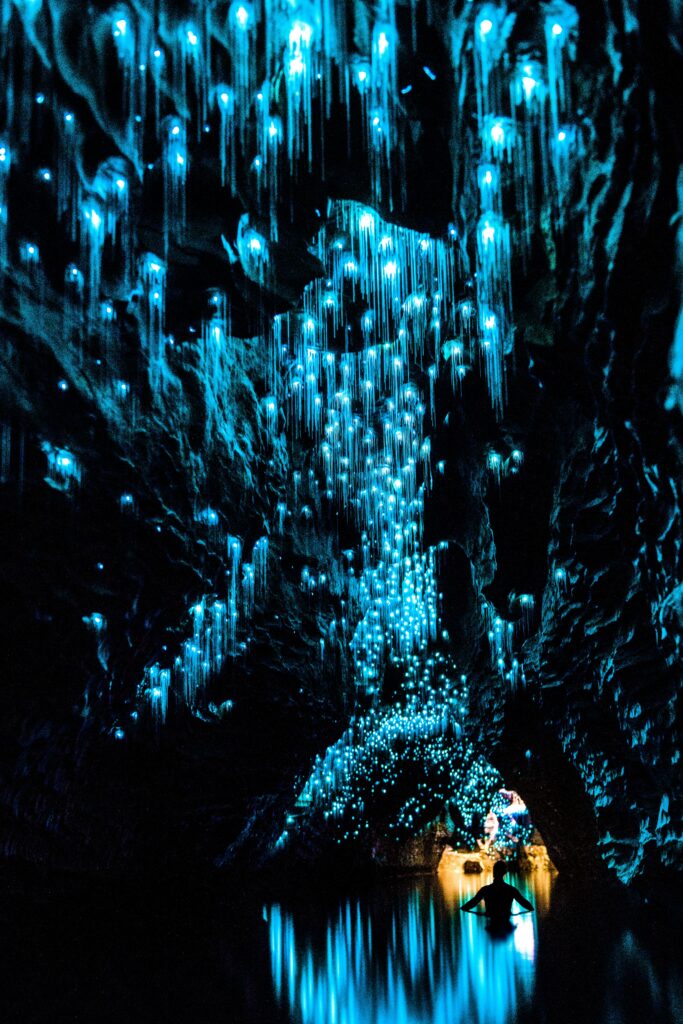
If you’ve ever wanted to stand in complete darkness and look up at what appears to be a perfect night sky, glowworm caves in the North Island of New Zealand will give you exactly that. Except you’re not outside, and those aren’t stars. They’re thousands of tiny bioluminescent larvae clinging to a cave ceiling, each one glowing a soft blue-green to lure in prey.
The North Island is home to the single most famous glowworm experience on Earth — Waitomo — along with more than a dozen other caves, forest walks, and waterways where you can see these strange little creatures for free or on a tour. Some visitors fly halfway around the world just for this. Others stumble onto a random roadside cave and have their minds blown without spending a cent.
This guide covers every worthwhile glowworm cave in the North Island, organized by region, with honest pros and cons, current pricing, the best time of year and day to go, and a full FAQ section answering the questions people actually type into Google before booking. Whether you want the full Waitomo boat-ride experience or a free forest walk nobody else knows about, you’ll find it here.
Quick Answer: Best Glowworm Caves North Island Has to uOffer
If you only read one paragraph, read this one. Waitomo is the best and most famous of the glowworm caves in the North Island, and it’s the only spot most first-time visitors need to prioritize. It sits about two hours south of Auckland and offers everything from gentle boat rides to full adrenaline black-water rafting. If you’re short on time or budget, Waipu Caves near Whangarei and the Ruakuri Bush Walk near Waitomo itself are completely free and still genuinely impressive.
| Cave / Location | Region | Tour or Free? | Best For |
|---|---|---|---|
| Waitomo Glowworm Cave | Waikato | Tour only | First-timers, classic boat ride |
| Ruakuri Cave | Waikato | Tour only | Wheelchair-accessible option |
| Spellbound Cave | Waikato | Tour only | Small-group boat experience |
| Waitomo Black Water Rafting | Waikato | Tour only | Adventure seekers |
| Ruakuri Bush Walk | Waikato | Free | Budget travelers near Waitomo |
| Waipu Caves | Northland | Free | Independent explorers |
| Waipu Caves Farm Park | Northland | Tour only | Families, easier access |
| Whatipu Caves | Auckland | Free | Combining a beach day |
| Kawiti Glowworm Caves | Northland | Tour only | Cultural experience with Māori guides |
| Abbey Caves | Northland | Closed | — (currently closed, see below) |
| Nikau Cave | Waikato | Tour only | Off-the-beaten-path caving |
| Lake Rotoiti Glow Worm Kayak | Bay of Plenty | Tour only | Combining hot springs |
| McLaren Falls Park | Bay of Plenty | Free / Tour | Easy evening walk near Tauranga |
| Te Auheke Track (Ōkataina) | Bay of Plenty | Free | Forest walk near Rotorua |
| Kākahi Glowworm Grotto | Manawatū-Whanganui | Free | Unique roadside cutting |
| Waterfall Gully | Auckland | Free | Quick city-adjacent option |
| Okupata Caves | Manawatū-Whanganui | Free | Off-grid, Tongariro area |
Now let’s get into the details of each one, region by region.
What Exactly Are Glowworms, Anyway?
Before you head into a cave expecting worms, here’s a quick reality check: New Zealand glowworms aren’t worms at all. They’re the larvae of a fungus gnat species called Arachnocampa luminosa, found only in New Zealand. The name “glowworm” stuck because the larval stage does look worm-like, but the adult insect resembles a mosquito.
A few facts worth knowing before your visit:
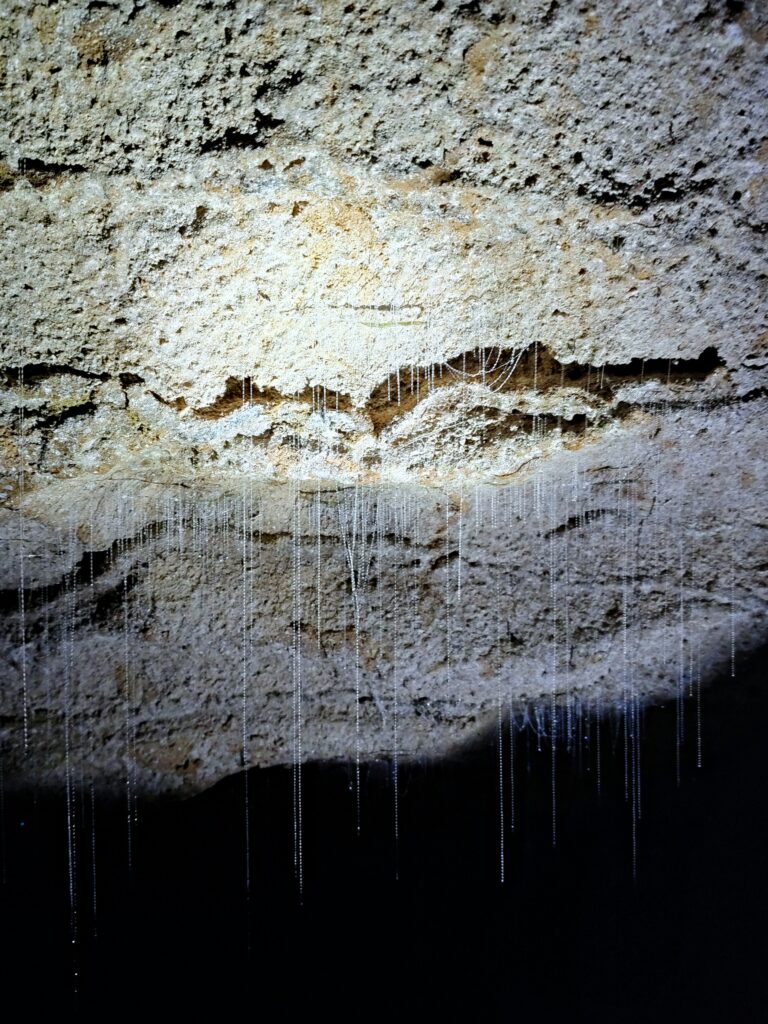
- They glow to hunt, not to look pretty. Each larva dangles dozens of sticky silk threads from the cave ceiling, then produces a soft blue-green bioluminescent light to attract flying insects like midges and moths. The insects fly toward the light, get stuck in the mucus-coated threads, and become dinner.
- They live most of their life as larvae. A glowworm spends around 6 to 9 months in the glowing larval stage, a couple of weeks as a pupa, and then emerges as an adult fly that lives for only a few days — just long enough to mate and lay eggs before dying, since the adults don’t even have functioning mouths to feed.
- The light gets brighter when they’re hungry. The glow is a chemical reaction (a form of bioluminescence) triggered by an enzyme called luciferase — the same broad chemical family responsible for firefly light.
- They’re territorial. Each larva claims its own patch of ceiling and threads; crowding or disturbing their space can cause them to retract their threads or dim their glow, which is part of why flash photography and loud noise are discouraged (more on that below).
- New Zealand is essentially the only place to see this at scale. Related glowworm species exist in parts of Australia, but the sheer density and accessibility of cave systems in New Zealand — especially across the glowworm caves of the North Island — make it the best place on the planet to witness this phenomenon.
For a deeper scientific look, the Department of Conservation’s glowworm page and Waitomo Caves’ own explainer are both excellent, reliable sources if you want to go further down the rabbit hole (or should we say, cave).
Best Time to Visit Glowworm Caves in the North Island
Good news: glowworms in New Zealand are visible year-round, since caves maintain a fairly consistent temperature and humidity regardless of season. That said, a few timing details genuinely change the experience.
| Factor | Recommendation |
|---|---|
| Time of day | After full darkness — at least 30 to 90 minutes after sunset for outdoor/forest sightings. Cave tours run on a fixed schedule and control lighting themselves. |
| Season | Winter (June–August) tends to bring darker, more humid conditions, which glowworms respond well to. However, caves are climate-controlled enough that any season works. |
| Weather | After rain is genuinely better for outdoor glowworm walks (forest tracks, roadside cuttings) since higher humidity increases their activity and glow intensity. |
| Crowds | December to February (Southern Hemisphere summer) and local school holidays are the busiest — book tours at least a few weeks ahead if traveling then. |
| Moon phase | For outdoor sightings only, a new moon or overcast night gives you darker conditions and a more dramatic view. |
If you’re combining a glowworm cave with other North Island travel, note that most of the popular caves (Waitomo especially) run tours throughout the day as well as evening sessions — cave interiors are dark regardless of what time it is outside, so a lunchtime boat tour looks essentially the same as one at 9 p.m.
If you’re mapping out a bigger Pacific or adventure-travel itinerary around this trip, our guide to Great Barrier Reef snorkeling covers a similar after-dark-meets-nature experience worth pairing with your New Zealand plans.
The Best Glowworm Caves in the North Island, Region by Region
Waikato Region: Waitomo, the Undisputed Capital
No article about glowworm caves in the North Island would be honest if it didn’t put Waitomo first. This small village, about a two-hour drive south of Auckland, has built its entire identity around these caves, and it’s genuinely earned the title “glowworm capital of the world.”
1. Waitomo Glowworm Cave
This is the original, most iconic glowworm experience in New Zealand, and it’s been welcoming visitors since 1889. The tour takes you on foot through limestone caverns filled with stalactites and stalagmites before ending with a silent boat ride through the Glowworm Grotto, where thousands of lights reflect off the still underground water.
- Duration: Around 45 minutes
- Price: Roughly NZ$65–75 for adults, with family and combo pricing available
- Accessibility: Some steps involved; not fully wheelchair accessible
- Good to know: No photography is allowed inside the Glowworm Grotto — flash light disturbs the worms and ruins the effect for everyone else, so just enjoy it with your eyes.
You can check current tour times and combo pricing on the official Waitomo Caves website.
2. Ruakuri Cave
Ruakuri stands out for being one of the only glowworm cave tours in the country that’s genuinely accessible — the tour begins with a long, gentle spiral ramp rather than steep stairs, making it suitable for wheelchair users, strollers, and anyone who’d rather avoid a lot of climbing. Inside, you’ll walk beneath waterfalls, past ancient fossils embedded in the limestone, and through sections lit by glowworms.
- Duration: Around 2 hours
- Price: Roughly NZ$95–100 for adults
- Best for: Travelers with mobility needs, or anyone who wants a slower, more immersive walk-through experience rather than a quick boat ride
3. Aranui Cave
Worth mentioning for balance: Aranui is often bundled with Waitomo and Ruakuri as a “triple cave” combo, but it does not actually contain glowworms. It’s included here so you don’t book it expecting them. Instead, Aranui is known for dramatic limestone formations and a short, easy bush walk to reach the entrance. If you want to see glowworms outdoors, the surrounding bush is worth a look after dark.
4. Spellbound Glowworm & Cave Discovery Tour
Spellbound offers a different angle on Waitomo’s glowworms — a smaller, boat-based tour through two separate cave systems, with a strong focus on storytelling and geology from your guide. Group sizes tend to be smaller than the main Waitomo Cave tour, which some travelers prefer.
- Duration: Around 3.5 hours (includes transport and two caves)
- Price: Roughly NZ$95–100 for adults
- Best for: Travelers who want more time and a more in-depth, less rushed experience
You can compare and book Spellbound tours through GetYourGuide.
5. Waitomo Black Water Rafting (Adventure Caving)
If a quiet boat ride sounds too tame, this is the answer. Black water rafting involves squeezing into a wetsuit, grabbing an inner tube, and floating through underground rivers beneath a canopy of glowworms — sometimes with sections of abseiling, jumping into pools, or climbing between passages.
There are two main tour levels:
- Labyrinth (roughly 3 hours): A solid introduction to black water rafting, with some walking, floating, and a bit of climbing.
- Black Abyss (roughly 5 hours): The full adventure version, including a 30-foot abseil into the cave system, waterfall jumps, and more technical caving.
Prices generally run from around NZ$150 to NZ$270 depending on the tour level and season. This is genuinely one of the most memorable adventure activities in the entire country, and it’s worth booking directly through the Waitomo Adventures site to see live availability.
6. Ruakuri Bush Walk (Free)
Here’s the free counterpart to everything above, and it deserves way more attention than it usually gets. The Ruakuri Bush Walk is a roughly 45-minute loop through native forest, past a natural limestone arch, alongside a river — and if you come back after dark with a torch, you’ll spot glowworms clinging to the banks and undercut cliffs along the trail, completely free of charge.
- Cost: Free
- Tip: Walk it during the day first to get familiar with the track, then return after full darkness. Turn your torch off periodically once you’re near the river sections to let your eyes adjust — that’s when the glow really shows.
7. Nikau Cave & Café
A lesser-known option close to Waitomo, Nikau Cave skips the boardwalks and handrails entirely — this is a raw, natural caving experience where you’ll do some genuine crawling and scrambling. It won’t have the sheer density of glowworms you’ll see at the main Waitomo cave, but it’s a fun, intimate alternative for travelers who want something a bit more adventurous without going full black-water rafting. There’s also inexpensive on-site accommodation and a small café if you want to make a night of it.
Northland Region: Free Caves and Cultural Experiences
Head north from Auckland and you’ll find a different flavor of glowworm cave — fewer crowds, more free options, and in one case, a genuinely unique cultural experience.
8. Waipu Caves (Free)
Waipu might be the best free glowworm experience in the entire North Island. Located about 40 minutes south of Whangarei (roughly two hours from Auckland), these caves are open to the public at no cost, year-round.
- Cost: Free
- What to expect: A short walk from the car park leads to the cave entrance. Inside, you’ll navigate a stream bed with a few sections requiring careful footing — it can get genuinely slippery, especially near the entrance, so sturdy closed-toe shoes are essential.
- Good to know: There’s a free campground nearby, plus rock climbing routes in the surrounding reserve, making Waipu a solid overnight stop if you’re road-tripping between Auckland and the Bay of Islands.
Because it’s unsupervised and unlit, Waipu is best suited to travelers who are reasonably confident on uneven, wet terrain. Bring a proper torch (not just a phone flashlight) and consider a headlamp so you have both hands free for scrambling over rocks.
9. Waipu Caves Farm Park (Milky Way Glow Worm Cave)
Just around the corner from the free public Waipu Caves is a separate, privately-run option that trades a bit of adventure for accessibility. Waipu Caves Farm Park offers guided tours with proper walkways and railings, making it a far more manageable choice for families with young children or anyone less confident scrambling through a wet, unlit cave.
- Price: Around NZ$40 for cave access; look for discounted combo tickets through booking platforms like BookMe
- Extras: On-site rock climbing and bouldering courses, plus a budget campground
10. Kawiti Glowworm Caves
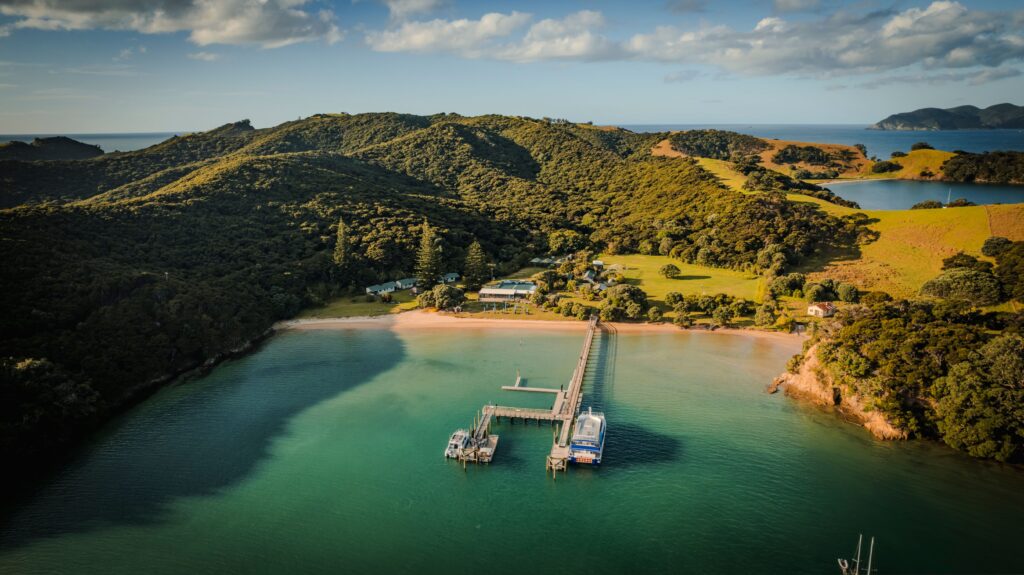
If you’re heading further north toward the Bay of Islands, the Kawiti Glowworm Caves offer something genuinely different from anywhere else on this list: a guided tour led by descendants of the legendary Māori chief Kawiti, blending cave exploration with local history and culture.
- Location: About 30 minutes from Paihia, in the native forest of Waiomio
- Price: Roughly NZ$50–200 depending on the tour type
- Special option: Twilight tours are available, some of which include a traditional dinner and a visit to the local marae (a Māori community meeting ground)
You can check availability through Kawiti Caves’ official site or via Viator.
11. Abbey Caves (Currently Closed — Please Note)
You may see Abbey Caves, near Whangarei, mentioned in older glowworm guides or forum posts. As of this writing, Abbey Caves remains closed to the public following a serious accident involving a child in 2023, according to the Whangarei District Council. The surrounding reserve is still open for walking, but entering the caves themselves is both unsafe and disrespectful given the circumstances. If you come across trip reports online claiming otherwise, verify current status with the council before planning around it.
Bay of Plenty & Rotorua Region: Glowworms Meet Geothermal Country
The area around Rotorua and Tauranga is best known for geothermal wonders, but it also hides several excellent — and mostly free — glowworm spots.
12. Lake Rotoiti Glow Worm Kayak & Hot Springs
This is one of the more unusual entries on this list: a nighttime kayak paddle across Lake Rotoiti to reach glowworm-covered caves only accessible by water, often combined with a soak in the nearby Manupirua natural hot pools overlooking the lake.
- Access: Tour only — the caves are genuinely hard to find independently
- Best for: Travelers who want to combine glowworm viewing with hot springs in one evening
Search for current availability through operators like Waimarino Tours or check the Lake Rotoiti Hot Pools website for combined packages.
13. Te Auheke Track, Lake Ōkataina Scenic Reserve (Free)
About 20 minutes from Rotorua, this forest trail leads to Cascade Falls, where you’ll find a mossy cliff face home to thousands of glowworms clinging to the rock. The walk is an easy 40-minute loop starting behind the Outdoor Education Centre.
- Cost: Free
- Directions: Turn onto Lake Ōkataina Road from State Highway 30 at Ruato
- Tip: If you’d rather not navigate in the dark alone, guided nocturnal tours from Rotorua are available and include transport and local commentary.
14. McLaren Falls Park (Free or Guided)
About 15 minutes from Tauranga, McLaren Falls Park has a short waterfall walking track that reveals glowworms after dark, plus the option to explore further via kayak or a guided canoe tour into a canyon with an even better display.
- Cost: Free for the walking track; guided canoe tours are a paid add-on
- Good to know: The park gate closes for entry at 7:30 p.m. in summer, but visitors already inside can exit later, so you won’t get locked in mid-walk.
Central North Island & Beyond
15. Kākahi Glowworm Grotto (Free)
Roughly 20 minutes from Taumarunui sits one of the most unusual glowworm sites on the North Island: a repurposed rail cutting that now hosts a roughly 100-meter stretch of steep, glowworm-covered walls. Since it was originally cut for a railway rather than carved naturally, the effect is almost tunnel-like — a straight corridor of tiny lights on either side.
- Cost: Free
- Directions: From State Highway 4, turn onto Waitea Branch Road, continue through the village, and follow signs to Te Rena Road
16. Waterfall Gully, Shakespear Regional Park (Free)
For travelers based in Auckland who don’t have time to drive to Waitomo, this is your closest legitimate option. Shakespear Regional Park, about an hour from the city center, has a short walking track leading to a waterfall gully with a glowworm display worth the detour.
- Cost: Free (regular regional park entry rules apply)
- Best for: Auckland-based travelers or anyone with very limited time
17. Okupata Caves, Tongariro Forest (Free)
For the truly off-the-beaten-path traveler, Okupata Caves sit within the Tongariro Forest Conservation Area. These are unmarked, unlit, and require a genuine sense of adventure (and ideally, local knowledge or a topographic map) to find and explore safely. The Department of Conservation’s Okupata Caves page has directions and safety notes — read them carefully before attempting this one independently.
Free vs. Paid Glowworm Caves in the North Island: Which Should You Choose?
Here’s the honest breakdown, since this is one of the most common questions travelers have.
| Free Options (Waipu, Ruakuri Walk, Kākahi, Te Auheke) | Paid Tours (Waitomo, Te Anau, Kawiti, Rotoiti) | |
|---|---|---|
| Cost | $0 | NZ$40–270 |
| Glowworm density | Moderate — you’ll see dozens to hundreds | High — often thousands in one view |
| Accessibility | Uneven terrain, no lighting, self-guided | Walkways, guided, often accessible |
| Experience | More adventurous, DIY | Curated, informative, comfortable |
| Best for | Budget travelers, independent explorers | First-timers, families, special occasions |
Our honest take: if you only have time or budget for one experience, make it Waitomo. It’s genuinely the best single glowworm display in the country. But if you’re road-tripping through the North Island anyway, pairing a free stop like Waipu or the Ruakuri Bush Walk with one paid tour gives you the best of both worlds without breaking the budget.
How Much Do Glowworm Cave Tours Cost in the North Island? (2026 Pricing)
| Experience | Approximate Price (NZD, adult) |
|---|---|
| Waipu Caves (free) | $0 |
| Ruakuri Bush Walk (free) | $0 |
| Waitomo Glowworm Cave | $65–75 |
| Waipu Caves Farm Park | $40 |
| Kawiti Glowworm Caves | $50–200 |
| Ruakuri Cave | $95–100 |
| Spellbound Cave Tour | $95–100 |
| Waitomo Black Water Rafting (Labyrinth) | $150–180 |
| Waitomo Black Water Rafting (Black Abyss) | $230–270 |
| Lake Rotoiti Glow Worm Kayak & Hot Springs | $90–140 |
Prices fluctuate seasonally and by operator, so always check the operator’s own site or a booking platform like BookMe, GetYourGuide, or Viator for current rates before your trip.
What to Pack for Visiting Glowworm Caves
- A proper torch or headlamp — essential for any free/self-guided cave or forest walk; your phone flashlight isn’t strong enough and drains your battery fast.
- Closed-toe shoes with good grip — cave floors and stream beds get slippery, especially at free sites like Waipu.
- A light jacket — most caves sit at a fairly constant, cool temperature year-round, even in summer.
- A change of clothes and towel — mandatory if you’re doing any black water rafting or wading through streams.
- No flash camera equipment for cave tours — flash photography is banned in nearly every commercial glowworm cave, since it disturbs the worms and ruins the darkness adaptation of everyone else’s eyes. Long-exposure tripod shots are sometimes allowed in outdoor, unsupervised locations — check signage first.
For more destination-specific packing tips, see our breakdown in the Montreal things to do guide, which covers seasonal gear the same way.
Photography Tips (Without Disturbing the Glowworms)
Getting a genuinely good glowworm photo is tricky, and it’s worth setting expectations before you go — most viral glowworm photos online are long-exposure shots that intensify the light far beyond what your eyes will actually see in person. That’s not a bad thing; the real experience in person feels more like a soft, twinkling blue-green sky rather than a neon display, and it’s still genuinely magical.
- Flash photography is prohibited inside virtually all commercial cave tours (Waitomo, Te Anau, Kawiti, etc.) — respect this, since it damages the worms’ feeding threads and ruins the view for other visitors.
- At free, outdoor sites like Waipu or the Ruakuri Bush Walk, a tripod and long exposure (several seconds, low ISO) can capture a more dramatic image — but only where signage doesn’t explicitly ask you not to.
- Manage your expectations: even with a good camera, most people find it’s better to simply be present and enjoy the moment with their own eyes rather than fight with settings in the dark.
Suggested Itineraries
A Perfect Weekend in Waitomo
- Friday evening: Arrive in Waitomo, settle into accommodation
- Saturday morning: Waitomo Glowworm Cave tour
- Saturday afternoon: Free time to explore the village, or add on Ruakuri Cave
- Saturday evening: Walk the Ruakuri Bush Walk after dark for a free, independent glowworm sighting
- Sunday: Black Water Rafting (Labyrinth tour) for a completely different perspective, then head back toward Auckland or Hamilton
A North Island Glowworm Road Trip (5–7 Days)
- Auckland — start with Whatipu Caves or Shakespear Regional Park if time is tight
- Waipu / Whangarei — free caves, campground, coastal scenery
- Bay of Islands — Kawiti Glowworm Caves and a cultural experience
- Waitomo — the main event, budget at least one full day, ideally two
- Rotorua / Bay of Plenty — geothermal sightseeing plus Te Auheke Track or McLaren Falls Park
- Optional detour — Kākahi Glowworm Grotto near Taumarunui if you’re heading toward Tongariro National Park
Prefer a slower, food-and-culture-first travel style instead of a packed road trip? Our Puerto Rico things to do guide follows a similar region-by-region breakdown if you’re deciding between destinations for your next trip.
Common Mistakes to Avoid
- Using flash photography — you’ll be asked to stop, and you’ll annoy everyone else on the tour.
- Wearing sandals to a free cave — the rocks and stream beds at places like Waipu are genuinely slippery.
- Booking Waitomo same-day in peak season — December through February and school holidays fill up fast, especially for Black Water Rafting.
- Assuming Aranui Cave has glowworms — it doesn’t; don’t be caught off guard on the combo tour.
- Talking loudly on the boat tour — the Waitomo boat ride is famously quiet and atmospheric; staying silent genuinely improves the experience for you and everyone else.
- Trying Abbey Caves anyway — the caves are closed for safety reasons; the surrounding reserve walk is fine, but don’t enter.
North Island vs. South Island Glowworm Caves: A Quick Comparison
While this guide focuses on the North Island, it’s worth a brief mention that the South Island has its own standout: Te Anau Glowworm Caves, near Fiordland, reachable by a scenic boat cruise across Lake Te Anau. If your trip only covers the South Island, Te Anau is a very worthy alternative. But if you’re weighing the two directly, the North Island — and Waitomo specifically — generally offers a larger number of caves, more variety (from gentle boat rides to full black water rafting), and significantly easier access from Auckland, New Zealand’s main international gateway.
Frequently Asked Questions About Glowworm Caves in the North Island
Where are the best glowworm caves in the North Island?
Waitomo is widely considered the best and most famous location for glowworm caves in the North Island, offering everything from a classic silent boat tour through the Glowworm Grotto to full adventure black water rafting. For a free alternative, Waipu Caves near Whangarei is one of the best self-guided options.
Are glowworm caves in the North Island worth visiting?
Yes. Even seasoned travelers who’ve seen bioluminescence elsewhere in the world consistently describe the Waitomo boat ride as one of the most memorable experiences in New Zealand. If budget is tight, the free options like Waipu Caves and the Ruakuri Bush Walk still deliver a genuinely magical sight without the cost of a guided tour.
How much does it cost to visit glowworm caves in the North Island?
Free options exist, like Waipu Caves and the Ruakuri Bush Walk near Waitomo. Paid tours range from around NZ$40 for basic cave access up to NZ$270 for a full black water rafting adventure experience. The standard Waitomo Glowworm Cave tour costs roughly NZ$65–75 per adult.
Can you see glowworms for free in the North Island?
Yes. Waipu Caves, the Ruakuri Bush Walk, Whatipu Caves, Kākahi Glowworm Grotto, Te Auheke Track, and Shakespear Regional Park’s Waterfall Gully are all free to visit. Free sites generally have fewer glowworms than large commercial caves like Waitomo, but they’re still an authentic and rewarding experience.
What is the best time of year to see glowworms in the North Island?
Glowworms can be seen year-round since most caves maintain stable temperature and humidity. Winter months (June to August) tend to offer slightly better conditions for outdoor viewing due to increased humidity and darker nights, but this makes little difference for commercial cave tours, which are dark and climate-controlled regardless of season.
What time of day should I visit glowworm caves?
For guided cave tours, any time of day works, since caves are naturally dark inside regardless of the hour. For free, outdoor sites like forest walks or roadside cuttings, you’ll need to visit after full darkness — ideally at least 30 to 90 minutes after sunset — for the best display.
Are glowworms actually worms?
No. New Zealand glowworms are the larvae of a fungus gnat species called Arachnocampa luminosa, found only in New Zealand. They’re often mistaken for worms because of their shape, but they’re insect larvae, not worms at all.
Why do glowworms glow?
Glowworms produce a blue-green bioluminescent light through a chemical reaction involving an enzyme called luciferase. The light attracts flying insects like midges and moths toward sticky, mucus-covered silk threads that hang from the ceiling, where the insects become trapped and eaten.
Can you take photos inside glowworm caves?
Flash photography is banned inside virtually every commercial glowworm cave tour in the North Island, including Waitomo, because it disturbs the worms and disrupts other visitors’ night vision. Non-flash long-exposure photography is sometimes permitted at outdoor, self-guided sites, but always check for posted rules first.
What’s the difference between a standard cave tour and black water rafting?
A standard glowworm cave tour, like the classic Waitomo experience, is a calm walking and boat-based visit suitable for most fitness levels. Black water rafting is a genuine adventure activity involving wetsuits, inner tubes, floating through underground rivers, and sometimes abseiling or jumping into pools — it requires reasonable fitness and comfort with cold water and confined spaces.
How long do glowworm cave tours take?
Waitomo’s standard Glowworm Cave tour runs about 45 minutes. Ruakuri Cave and Spellbound tours typically run 2 to 3.5 hours. Black water rafting tours range from 3 hours (Labyrinth) to 5 hours (Black Abyss), including transport, briefing, and gear setup.
Is Waitomo better than other glowworm caves in the North Island?
For sheer scale and glowworm density, Waitomo is generally considered the top choice in the North Island. However, options like Kawiti offer a unique cultural angle with Māori-guided tours, and free sites like Waipu Caves and the Ruakuri Bush Walk offer a more independent, adventurous experience for travelers on a tighter budget.
Are glowworm caves suitable for kids?
Most standard glowworm cave tours, including Waitomo’s main Glowworm Cave and Kawiti, are family-friendly and suitable for children of most ages. Adventure options like black water rafting generally have minimum age and fitness requirements, so check with the specific operator before booking for younger children.
Can you see glowworms outside of caves?
Yes. Glowworms don’t strictly need caves — they need darkness, moisture, and often a vertical surface like a cliff face, riverbank, or forest cutting. Locations like the Ruakuri Bush Walk, Te Auheke Track, Kākahi Glowworm Grotto, and Waterfall Gully all showcase glowworms in open-air, natural settings rather than underground caves.
Do I need to book glowworm cave tours in advance?
For popular tours like the standard Waitomo Glowworm Cave, booking a few days ahead is usually sufficient outside of peak season. However, for black water rafting, small-group tours like Spellbound, or any visit during December to February or New Zealand school holidays, booking at least a few weeks in advance is strongly recommended, since these tours sell out.
Final Thoughts on Glowworm Caves in the North Island
Between the sheer scale of Waitomo’s Glowworm Grotto, the adrenaline of black water rafting, the cultural depth of Kawiti, and the quiet, free magic of places like Waipu Caves and the Ruakuri Bush Walk, the glowworm caves of the North Island genuinely offer something for every kind of traveler and every kind of budget. This isn’t a one-and-done attraction you tick off a list — it’s the kind of experience that tends to earn a place near the top of people’s “best things I did in New Zealand” stories, years later.
If you’re planning a North Island itinerary, our advice is simple: don’t skip Waitomo, but don’t stop there either. Pair the classic boat tour with at least one free, independent glowworm walk, and you’ll come away with a much fuller picture of just how special this tiny, glowing creature — found almost nowhere else on Earth — really is.