
The oldest restaurant in the world is Sobrino de Botín, at 17 Calle de Cuchilleros in Madrid, Spain. Founded in 1725 by the French cook Jean Botín, it has served food without interruption for over 300 years and holds the official Guinness World Record as the world’s oldest operating restaurant.
There is a dark wooden door on a cobblestone lane in old Madrid that has been opening for the same reason for three hundred years. Behind it, a wood-fired oven has been burning since 1725. The same recipes pass down through the same family. And every visitor asks the same question: is this really the oldest restaurant in the world?
According to the Guinness Book of World Records, yes. Sobrino de Botín is the oldest restaurant in the world still operating today — and still operating under the same name in the same location. It predates the United States by half a century. It was already forty years old when Mozart was born. It has outlasted empires, revolutions, two world wars, and a civil war fought on its own doorstep.
This guide covers everything: the full history, the famous dishes, the Hemingway connection most visitors miss, how to book, what it costs, and how Botín compares to the other ancient restaurants of the world.
What Is the Oldest Restaurant in the World?
The oldest restaurant in the world is Sobrino de Botín in Madrid, Spain. Founded in 1725, it is certified by Guinness World Records as the world’s oldest restaurant in continuous operation. The key phrase is “continuous.” Not the oldest building that once served food. Not the oldest family linked to cooking. The oldest working restaurant and the oldest place that has fed paying customers, every year, without a break, since the early eighteenth century.
It sits at 17 Calle de Cuchilleros, in the Barrio de los Austrias — the Habsburg Quarter — just south of the Plaza Mayor. No other establishment has challenged the title with comparable documentation. That makes Botín not only the oldest restaurant in Spain and the oldest Spanish restaurant in continuous service, but the oldest still-running restaurant anywhere on earth.
The History of Sobrino de Botín
A Building Born in 1590
The story starts before the restaurant. The building on Calle de Cuchilleros appears in records as early as 1590, just thirty years after King Philip II made Madrid the permanent capital of the Spanish Empire. The city was exploding in size — palaces rising, churches multiplying, the streets around the future Plaza Mayor becoming the commercial spine of a world-spanning empire. The stone façade still carries an inscription marking 1725, the year the restaurant claims as its founding.
Jean Botín: The Frenchman Who Started It All
In 1725, a French cook named Jean Botín arrived in Madrid with his Asturian wife and opened a small inn and eating house here. French technique — precise, oven-focused — met the hearty traditions of Asturian cooking from Spain’s northern coast, and the result had a character customers recognized at once.
The wood-fired oven Jean Botín installed became the heart of the kitchen, and it has never been turned off. In Spanish, “Sobrino de Botín” means “nephew of Botín” — a name that arrived later but has stuck for well over a century.
The Nephew Who Gave It Its Name
The restaurant changed hands several times. By the mid-1800s the Botín name was attached to an establishment in the Plaza de Herradores run by José Puertas Sánchez, nicknamed “Botín.” When he died in 1847, his nephew Cándido Remis Puertas took over. In 1865 Cándido opened his own place at 17 Calle de Cuchilleros, naming it for the nephew of Botín — sobrino de Botín. That is the name the restaurant still carries today.
The González Family
In the 1930s, a married couple — Amparo Martín and Emilio González — took ownership during one of the most dangerous decades in Spanish history, the years around the Spanish Civil War. Madrid was besieged, bombed, and fought over street by street. Botín survived. The González family has run it ever since, approaching ninety years of stewardship. In 2025 they presided over Botín’s 300th anniversary, covered by Smithsonian Magazine, CBS News, and outlets across sixty countries.
The Guinness World Record: What “Continuous Operation” Means
The Guinness World Record for the oldest restaurant is not handed out loosely. The criteria require a fixed, identified location; genuine commercial restaurant service to paying customers; unbroken continuity with no closure-and-reopening gap; and documentary evidence strong enough to back the claim.
Botín satisfies all four. Its address has not changed. Its records of operation are well documented, thanks in large part to the González family’s careful preservation of its history. And the oven, at least symbolically, has never gone cold. That unbroken chain is the single thing that separates Botín from every older building that has, at some point, stopped serving.
Source: Guinness World Records
Why Is Sobrino de Botín So Famous?
Ernest Hemingway and The Sun Also Rises
The biggest driver of Botín’s international fame is not the record. It is a novel from 1926. Ernest Hemingway spent long stretches in Madrid in the 1920s, soaking up the bullfights, the bars, and the food. He gave the final pages of The Sun Also Rises to a dinner at Botín, where his protagonist Jake Barnes eats roast suckling pig and drinks rioja. The scene is one of the most famous restaurant references in English literature, and it sent generations of readers to Madrid with one mission: eat where Jake Barnes ate.
Today the restaurant keeps a “Hemingway table” and displays its Guinness certificate in the front window. Scholars believe Hemingway’s actual visits were more likely to the earlier “Antigua Casa Botín” in the Plaza de Herradores, but for literary tourism the distinction is academic — the connection has belonged to the current restaurant for a century.
Francisco Goya: The Dishwasher Who Became a Legend
Here is the fact that stops people mid-sentence. Before Francisco Goya became one of Spain’s greatest painters — before The Third of May, before the Black Paintings — he reportedly worked as a dishwasher at Botín as a young man.
Goya was born in 1746, a generation after the restaurant opened, and his early Madrid years were lean. The story is widely repeated though impossible to verify to documentary certainty.
If true, the same oven that now roasts suckling pig for visitors from sixty countries once heated the kitchen where Spain’s defining painter scrubbed pots and wondered about his future.
The Wood-Fired Oven That Has Never Gone Cold
At the heart of the kitchen is a wood-fired oven the restaurant says has burned continuously since 1725. It is fueled by juniper wood (enebro), which gives the meat a faint, resinous aroma no modern oven can copy. Three centuries of accumulated heat and absorbed flavor have made it one of the most storied pieces of kitchen equipment anywhere. The claim of unbroken burning cannot be verified to the exact day, but it has been reported as fact by Smithsonian Magazine and CBS Sunday Morning, and it is the reason the food tastes the way it does.
Signature Dishes at Sobrino de Botín
Cochinillo Asado (Roast Suckling Pig)
This is the dish. A whole young pig, slow-roasted in the wood-fired oven until the skin turns deep amber and shatters at the lightest touch. The meat beneath is extraordinarily tender, pale, and mild. The Botín tradition is to carve it tableside with the edge of a ceramic plate rather than a knife — proof of how soft the meat is — and then smash the plate for luck. It is theater performed with complete seriousness, and it works every time. It comes with nothing more than roasted potatoes. The pig is the point.
Cordero Asado (Roast Baby Lamb)
Equal in reputation, the cordero asado is the other great product of the oven: baby lamb given the same minimalist treatment of juniper smoke, dry heat, time, and restraint. The result is clean and sweet, with a crisp exterior and none of the gaminess that puts people off lamb elsewhere.
Sopa de Ajo (Garlic Soup)
One of the oldest recipes on the menu, and one of the most satisfying. An egg is poached directly in a broth of chicken stock, sherry, and garlic, thickened with torn bread. For centuries it was the restorative of choice for Madrid’s late-night workers and revelers. If you order nothing else before your roast, order this.
Gazpacho and the Full Menu
In warmer months the gazpacho — cold, vivid red, built on ripe tomatoes, cucumber, pepper, garlic, sherry vinegar, and good olive oil — is the ideal opener. Beyond the headliners, the menu runs through traditional Castilian and Madrileño cooking: house-made croquetas, baked eggs, grilled fish, seasonal vegetables, and desserts including crema catalana and Spanish cheese. The wine list leans on Ribera del Duero and Rioja. If you love a great food destination with a story, Botín belongs on the same list as other unforgettable tables — the kind of place I wrote about in my guide to Café Jacqueline in San Francisco, where a single dish and a single owner defined the whole experience.
Visiting the Oldest Restaurant in the World: A Practical Guide
Address
Sobrino de Botín
17 Calle de Cuchilleros
28005 Madrid, Spain
Where is the oldest restaurant in the world? It is here: just south of the Plaza Mayor, at the foot of a stone staircase that drops from the square into one of Old Madrid’s most atmospheric lanes. It is easily walkable from the Ópera, La Latina, and Sol metro stations.
Opening Hours
Open seven days a week, 1:00 PM to 11:30 PM (13:00–23:30). Botín does not close between lunch and dinner — the kitchen runs straight through the afternoon, which is unusual in Spain.
Reservations
Reservations are effectively essential for dinner, especially on weekends and through the peak months of May to September. Book directly at botin.es, where an English-language system is available; TheFork and TripAdvisor also carry live availability. When booking, request the wine cellar (la bodega) — the vaulted underground room reached by a winding stone staircase. It is the most atmospheric space in the building, and it books out first.
Prices: What to Expect
Starters run roughly €10–18, and the main roasts (cochinillo, cordero) around €26–34. A full meal with house wine lands at about €40–65 per person, with set menus sometimes available for €35–45. This is not a budget meal, but for the history, the atmosphere, and the food quality, most visitors consider it excellent value.
Dress Code and What to Expect Inside
There is no strict dress code; smart casual is right. The building spans four floors, each with its own character — the ground floor busy and close to the oven, the upper floors quieter, the cellar the most theatrical. Service is formal, knowledgeable, and proud, and staff speak excellent English. Allow two to two-and-a-half hours; the kitchen does not rush.
Best Time to Visit
Weekday lunch (1:00–3:30 PM) is the most relaxed window — lower occupancy, full menu, afternoon light on the streets outside. Autumn and spring are the best seasons for Madrid generally, while winter evenings in the cellar, with the oven blazing, have a magic of their own.
Nearby Attractions: Building a Madrid Itinerary Around Botín
Botín sits in one of Europe’s most historically concentrated neighborhoods. The hours before your reservation are a gift — use them.
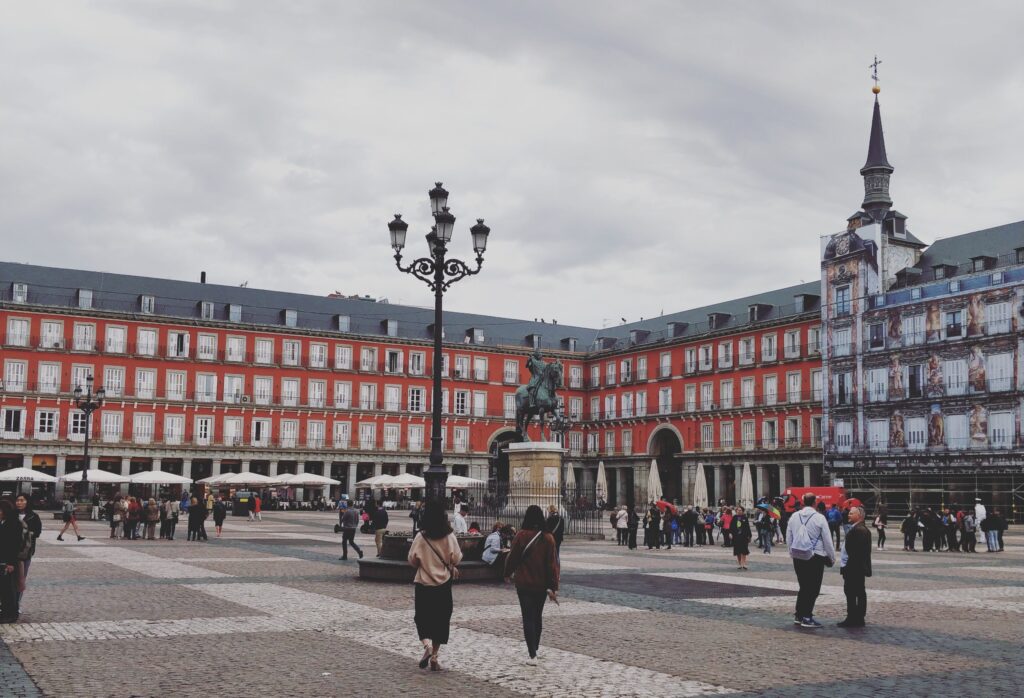
Plaza Mayor (2-minute walk) — One of Spain’s defining public squares, built 1617–1619 under Philip III. Go in the late afternoon when the light turns golden and the tour groups thin out.
Mercado de San Miguel (5-minute walk) — A stunning iron-and-glass market from 1916, ideal for a pre-dinner glass of vermouth and a plate of jamón ibérico. Busiest and best between 7 and 9 PM.
Palacio Real (20-minute walk) — Europe’s largest royal palace by floor area, still the official residence of the Spanish crown. The state rooms, Royal Armory, and tapestries are all worth your time.
Chocolatería San Ginés (10-minute walk) — Open since 1894, serving hot chocolate and churros to Madrid’s night owls. A perfect post-dinner stop.
Other Historic Restaurants Around the World
Botín holds the record, but it belongs to a remarkable global family of restaurants old enough to be their own category of human achievement. Here is how the world’s oldest restaurants compare:
| Restaurant | Location | Founded | Known For | Guinness? |
|---|---|---|---|---|
| Sobrino de Botín | Madrid, Spain | 1725 | Cochinillo asado, Hemingway connection | ✅ Official record holder |
| Piwnica Świdnicka | Wrocław, Poland | 1273 | Oldest in Europe; Świdnickie beer (closed 2017) | — |
| Honke Owariya | Kyoto, Japan | 1465 | Hourai soba noodles, imperial cuisine | Oldest restaurant in Japan |
| La Tour d’Argent | Paris, France | 1582 | Pressed duck, the first table fork in France | — |
| Zur Letzten Instanz | Berlin, Germany | 1621 | German pork knuckle, Napoleon connection | Oldest restaurant in Berlin |
| Caffè Florian | Venice, Italy | 1720 | Italian café culture, literary clientele | Oldest café in Italy |
| Den Gyldene Freden | Stockholm, Sweden | 1722 | Nordic cuisine, Swedish Academy home | Oldest tavern (Sweden) |
| St. Peter Stiftskulinarium | Salzburg, Austria | ~803 AD | Medieval monastery inn, Charlemagne era | Oldest inn in Central Europe |
Piwnica Świdnicka — Wrocław, Poland (est. 1273)
Hidden in the Gothic cellars beneath Wrocław’s Old Town Hall, Piwnica Świdnicka has poured beer and served food since 1273, making it by founding date one of the oldest dining rooms in Europe. It is sometimes called Europe’s oldest restaurant, but it cannot claim the Guinness world title for one decisive reason: it closed in 2017 and its operation was interrupted. Continuity — the very thing Botín has never broken — is exactly what separates the two.
La Tour d’Argent — Paris, France (est. 1582)
Paris’s oldest restaurant overlooks the Seine opposite Notre-Dame and has served since 1582, when it opened as an inn under Henri III. Legend holds that King Henri IV introduced the table fork to France here. Today it is a Michelin-starred institution famous for its numbered pressed duck. It does not hold the Guinness title — its early continuity is poorly documented and it closed during the French Revolution — but as a slice of culinary history it is unmatched in Paris.
St. Peter Stiftskulinarium — Salzburg, Austria (est. AD 803)
The oldest inn in Central Europe sits inside St. Peter’s Abbey in Salzburg. Its first recorded mention comes from AD 803, when Alcuin of York, an advisor to Charlemagne, referenced hospitality at the monastery — over 1,200 years of recorded history. So why isn’t it the world’s oldest restaurant? Because Guinness requires continuous commercial restaurant service, and monastic hospitality across twelve centuries does not consistently meet that bar. St. Peter is listed instead as the oldest inn in Central Europe.
Honke Owariya — Kyoto, Japan (est. 1465)
Japan’s oldest restaurant began in 1465 as a confectionary before turning to the buckwheat soba noodles that made it famous. It has served monks, shoguns, and emperors for more than 550 years. Its signature Hourai Soba arrives as five stacked lacquer boxes with eight accompaniments — a dish so refined it has not needed adjustment in five centuries. It does not hold the Guinness record, but in pure culinary lineage it may be the most extraordinary dining institution on earth.
Den Gyldene Freden — Stockholm, Sweden (est. 1722)
Just three years older than Botín by founding date, Den Gyldene Freden opened in Stockholm’s Gamla Stan in 1722 and has been the living room of Sweden’s cultural elite ever since. The Swedish Academy — which awards the Nobel Prize in Literature — still holds its Thursday dinners here. Two original 1722 dining rooms remain structurally unchanged.
Zur Letzten Instanz — Berlin, and Caffè Florian — Venice
Berlin’s oldest restaurant, Zur Letzten Instanz, opened in 1621 near the courthouse district; Napoleon is said to have dined there in 1806. Venice’s Caffè Florian, opened in 1720 on Piazza San Marco, is Italy’s oldest café, with Byron, Dickens, Goethe, and Proust among its former regulars. Neither holds the world record, but both are living pieces of European history.
Can Any Restaurant Challenge Botín’s Record? The Casa Pedro Controversy
In June 2025, an AP News story broke an intriguing challenge to Botín’s title — from another restaurant in Madrid. Casa Pedro, a family-owned tavern in the Fuencarral district, announced it had hired a professional historian and begun searching the city’s municipal archives to prove the family has operated a restaurant on the same premises since 1702 — which would make it 23 years older than Botín. CBS Sunday Morning covered the rivalry in November 2025.
As of mid-2026, the Guinness World Record remains with Sobrino de Botín. The criteria demand documented, continuous, verifiable operation, and oral family history — however authentic — does not satisfy that standard without dated records. Casa Pedro’s historian is still working through the archives. Whether enough documentation emerges to challenge the record formally remains to be seen.
Interesting Facts About the World’s Oldest Restaurant
The wood-fired oven has reportedly burned continuously since 1725, fueled by juniper wood and never extinguished in over 300 years.
Francisco Goya reportedly worked as a dishwasher here before becoming Spain’s greatest painter.
Ernest Hemingway referenced Botín in the closing pages of The Sun Also Rises (1926).
The Guinness certificate is displayed in the window, visible from the street.
The building dates to 1590 — 135 years before the restaurant opened.
The restaurant spans four floors, including a vaulted underground wine cellar.
The González family has owned and run it since the 1930s.
Suckling pig is carved tableside with a ceramic plate, not a knife — then the plate is smashed for luck.
Botín celebrated its 300th anniversary in 2025, covered by media from 60+ countries.
It has over 12,000 TripAdvisor reviews, among the most of any restaurant in Spain.
“Sobrino” means “nephew” — the restaurant is named for the nephew of the original Botín.
Botín opened offshoots in Miami, Mexico, and Puerto Rico, all since closed. If Puerto Rico is on your own radar, my guide to things to do in Puerto Rico covers the island’s own food and history. The original Botín, meanwhile, has never moved.
FAQ: The Oldest Restaurant in the World
What is the world’s oldest restaurant called?
It is called Sobrino de Botín, at 17 Calle de Cuchilleros in Madrid, Spain. Founded in 1725, it is certified by Guinness World Records as the oldest restaurant in continuous operation.
What is the oldest restaurant still operating?
Sobrino de Botín in Madrid is the oldest restaurant still operating in the world, founded in 1725 and serving continuously for over 300 years. A rival claim from Casa Pedro in Madrid (founded 1702) is under historical review.
Is Botín in Madrid worth visiting?
Overwhelmingly yes. The cochinillo asado and cordero asado are excellent, the atmosphere is unique, and the history is real. Expect to pay €40–65 per person for a full meal with wine.
How old is the oldest restaurant in the world?
Sobrino de Botín was founded in 1725, making it 301 years old as of 2026. It celebrated its 300th anniversary in 2025.
How do you make a reservation at Sobrino de Botín?
Book directly at botin.es, or via TheFork and TripAdvisor. Reservations are essential, especially for weekends and summer evenings. Request the wine cellar for the most atmospheric experience.
What is the most famous dish at Botín?
The cochinillo asado — roast suckling pig cooked in the original wood-fired oven, carved tableside with a ceramic plate and served with roasted potatoes.
Did Ernest Hemingway really eat at Botín?
Yes. Hemingway dined at Botín-associated establishments during his 1920s stays in Madrid and immortalized the experience in The Sun Also Rises. Scholars believe his visits were most likely to the “Antigua Casa Botín,” but the literary connection has defined the current restaurant for a century.
What is the oldest restaurant in Europe?
By Guinness criteria, Sobrino de Botín (1725) holds the official title. St. Peter Stiftskulinarium in Salzburg has records dating to AD 803 but occupies a different category — oldest inn in Central Europe. Piwnica Świdnicka in Wrocław (1273) is older still by founding date but closed in 2017.
What is the second oldest restaurant in the world?
By founding date, Den Gyldene Freden in Stockholm (1722) is just three years younger than Botín and is often cited as the runner-up among continuously operating restaurants.
How much does it cost to eat at the oldest restaurant in the world?
Roughly €40–65 per person for a full meal with wine. Set menus are sometimes available for €35–45. The cochinillo and cordero are the priciest mains.
What are Botín’s opening hours?
Open seven days a week, 1:00 PM to 11:30 PM (13:00–23:30), with no break between lunch and dinner service.
Is the wood-fired oven really 300 years old?
The restaurant claims the oven has burned continuously since 1725. It is widely reported by Smithsonian Magazine and CBS News and cannot be verified to the exact day, but the oven is genuinely old, original in design, and central to how the food tastes.
Conclusion
Three hundred and one years is a long time for anything to remain itself. Most restaurants fail within five years. Most buildings fall to fire or neglect. Most families lose interest and move on. Sobrino de Botín has done none of these things. It is still on the same street, in the same building, cooking the same recipes in the same oven, under the same family that took over ninety years ago.
The oldest restaurant in the world is also, in the judgment of hundreds of thousands of diners, simply a very good restaurant. That combination — extraordinary history and genuinely excellent food — is what makes it unlike anywhere else on earth. Make the reservation. Request the cellar. Order the cochinillo.
Pingback: Cafe Jacqueline: San Francisco's Soufflé Legend Has Closed